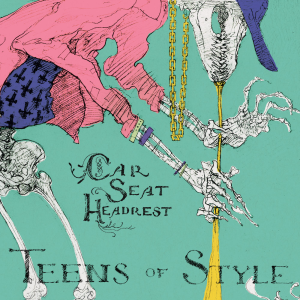
1) Fill in the Blank; 2) Vincent; 3) Destroyed by Hippie Powers; 4) (Joe Gets Kicked Out of School for Using) Drugs with Friends (But Says This Isn't a Problem); 5) Not What I Needed; 6) Drunk Drivers/Killer Whales; 7) 1937 State Park; 8) Unforgiving Girl (She's Not An); 9) Cosmic Hero; 10) The Ballad of Costa Concordia; 11) Connect the Dots (The Saga of Frank Sinatra); 12) Joe Goes to School
Colossal, sprawling, whimsical, passionate. Car Seat Headrest lay everything they have down to establish themselves in their new, four-man form, and create one heck of a ride of emotional rollercoasters and poignantly powerful rock and roll.
Key tracks: "Vincent", "Drunk Drivers/Killer Whales", "The Ballad of Costa Concordia"
Towards the end of the already colossal Teens of Denial (12 songs but 70 minutes) lies the near 12-minute multi-part epic "The Ballad of Costa Concordia" - an ambitious beast of a song which is the ultimate testament to Toledo's self-biting introspection across several verses, moving from desperation to anxious release. It's the album's big emotional gut-purge moment. Also, one of its verses is a direct homage to the chorus of Dido's "White Flag". If you needed to distill the entire album into one moment, this'd be an appropriate choice: personal gut-spilling lackadaisically cut by an almost undermining levity.
Will Toledo's self-release demo albums got a following in part because of the sheer ambition they displayed: it was a clear that they were the work of someone whose ideas had a far wider scope than the home recordings could stretch to. Where Teens of Style was a quick blast of an introduction to kick off the story of Car Seat Headrest as a recording artist, made out of songs from the self-release days, it's Teens of Denial that's the real follow-up to those albums. It's the realisation of what happens when that vision gets to be unchained, with a little more experience under the belt but the more idiosyncratic features of Toledo's songwriting kept intact - or left to spread even wider.
Teens of Denial could very well be an epic-scale ode to millennial self-doubt, the ultimate 2010s answer to the introspection of the late 90s slacker indie rock that the whole Car Seat Headrest project is so clearly inspired by, but Toledo has a wicked and playful mind that sets out to skew that. What makes Teens of Denial truly itself is the off-kilter sense of humour it has for everything it stands for. The self-jabs are as much as tongue-in-cheek as they are real, the confessionals and genuine glances at the world and people affected by a variety of mental health issues are almost always closed with a punchline to take away the tension, and like any person grown up with the internet it's full of references from fitting to ridiculous. Famous names flicker throughout the lyrics, there's that Dido reference, "Not What I Needed" started out at as an evolved interpolation of The Cars' "Just What I Needed" - and when Ric Ocasek drew back the rights at the last minute, Toledo's solution was to replace the interpolated part with a backwards sample of "Something Soon" from Teens of Style, extending the references to himself. There's an irreverential sense of humour to Toledo's writing: he's aware of his own melodrama and musical influences and he's having fun with it rather than draping himself in earnestness. Which, in return, lends him a particularly unique writing voice that can easily go into a love-it-or-hate-it territory. And if you do love it, Teens of Denial is a real gold mine of immortal one-liners and honestly resonant verses, mingling together in page-long verses and punctuated by a particularly erratic wit.
(As a side point, the initial pressings of the album did feature "Not What I Needed" with the Cars part still intact and the original copy is still floating out there. Honestly, even though the original version might flow a little better musically, the abrupt remake has an intensity and mentality that suits the rest of the album better, and its sudden cacophony gives the otherwise rather relaxed song a heck of an ending. I reckon Ocasek's camp might have done Toledo a favour)

It's also important to note that at this stage, Car Seat Headrest have become a band. Toledo's the central force and always will be even if he'll sometimes protest about it, but the crew - Andrew Katz on drums, Ethan Ives on guitar, Seth Dalby on bass - make their formal introduction here and there's an immediate distinction to be made. The new Car Seat Headrest are an instrumentally tight group of really talented musicians and their dynamic playing gives the project a whole new set of energy - particularly Katz' drumming which here already makes a strong point about being a signature element of the band. The album doesn't waste time highlighting it either. "Fill in the Blank" takes the general liberatingly noisy rock sound of Teens of Style but re-introduces it with a full band in tow, and then "Vincent" comes in to really drive the point across. "Vincent" is a stretched beast of a song, seven minutes of a coiled spring winding tighter until it snaps to life, flicking nonchalantly between intensely interplaying energy and moments of free-falling explosions. It, if anything, shows just how well the new band near telepathically reacts and adapts to Toledo's style of songwriting, moving between tempos and moods without batting an eye. When the new Car Seat Headrest go on full-guitar mode, e.g. "Destroyed by Hippie Powers" or "1937 State Park", they're one of the most vitalised full-on rock bands of the 2010s by far and you can hear it in the sheer power they bring out.
Teens of Denial is a sprawling album, in a manner that seems it's growing wildly rather than designed as such. The songs act as if they flow so freely wherever they want and Toledo can't quite keep them in bay, and he then joins in. The verses and choruses mismatch, outros find themselves extending beyond their original scope and Toledo's performance switches from cool and collected to shouting in the room for no apparent reason: if Toledo paints himself as a mess of a person in the lyrics, then the music follows suite. It's nothing new to Toledo, this is what his original releases were full of, but on Teens of Denial it becomes a strength. There's a particular kind of awe you can feel when confronted with something that feels like a hurricane threw an abundance of miscellaneous ideas all over the front yard but which then makes that mess into a coherent statement, and that's exactly what happens here. The album's jumps back and forth are something exciting, and the key part there is that each of those parts is something memorable, something to cling to. No matter if drenched in distorted guitars, chiming with surprising clarity or taking inspiration somewhere more off the road like the excellent slacker americana of "Drugs with Friends", each melody plays out with strength; each hook holds a great big grip; each song contains something that shouts out and stands up in a near-iconic fashion. The big epics of the album demonstrate this effectively, whether it's the building intensity of "Vincent", the jam-like explosive finale that follows the more refined, organ-accentuated first half of "Cosmic Hero", or the overall stand-out bombast of "The Ballad of Costa Concordia". The last one is an undeniable highlight and perhaps intended to be so, acting as a microcosmos of the many faces of Car Seat Headrest, peaking with its rambling middle-section where Toledo explodes into a rant; a real iconic discography moment.
The heart and key of it all is "Drunk Drivers/Killer Whales". Each Car Seat Headrest album contains that one humongous monolith of a moment where every element of Toledo's musical traits click perfectly together, and the stunning "Drunk Drivers/Killer Whales" is it for Teens of Denial. The choruses alone are the stuff immortal alt. rock moments are made out of, and its changing verses keep throwing new tricks out of their sleeves. With the rest of the album having such a wild attitude, the practically po-faced delivery of "Drunk Drivers" jumps out as the part where Toledo cuts any peripheral notions and focuses on only delivering a song with importance and gravitas, and he succeeds brilliantly. For six and a half minutes everything is completely clear and open; Car Seat Headrest speaking to you and you only with sincerity, with none of the self-consciousness that the rest of the album is so full of, none of the jokes cutting down the weight in the meaning of his words.
Not that the glibness elsewhere in the record is a bad thing. Like throwing a Dido callback in the middle of an emotional centerpoint, the whole of Teens of Denial thrives on constantly positioning its honesty next to an acknowledgment of its own pretensions - the light-hearted counterpoints build up the importance of the more serious moments, and vice versa. It isn't a difficult album, but the constant playing around with its own tropes, the musical and tonal wanderlust and the long rapid-fire lyric sheets with words for days can get a bit too much at first, but that also feels like the point. It's an ambitious record, meant to sound like a big deal from day one, as a real establishing moment for Toledo and Car Seat Headrest (a proper one after the attic clearance of Teens of Style) - and Car Seat Headrest's way to go about is to overload the record with everything they can think of without worrying whether it's going to hold together. But it does, to a most brilliant extent. Each song finds the band placing their everything into its recording, and it's hard not to admire the amount of scope, guts and craftsmanship that's placed into each song. Time will tell how many of its traits hold up against the future of the band but up until this point, this sounds like the culmination of everything all those demo records hinted towards. It's Toledo establishing his sound and voice bolder than ever before in what seems like an intentional aim to create a masterpiece record. Perhaps it's not 100% there per se from a completely subjective perspective, but that's not even close to any real criticism: Teens of Denial is one of the landmark records of 00's indie, and earns the heck out of that title.