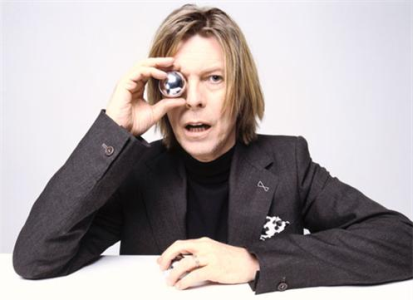
1) The Wedding; 2) You've Been Around; 3) I Feel Free; 4) Black Tie White Noise; 5) Jump They Say; 6) Nite Flights; 7) Pallas Athena; 8) Miracle Goodnight; 9) Don't Let Me Down & Down; 10) Looking for Lester; 11) I Know It's Gonna Happen Someday; 12) The Wedding Song
Bowie starts his 1990s with a smooth jump to a new sound, and makes it his own so well that he's actually created a consistent record.
Key tracks: "Jump They Say", "Pallas Athena", "Miracle Goodnight"
The 1990s were a reset for Bowie. Much has been made out of his 80s albums - probably too much - but it's clear that towards the end of the decade his magic had started to wane for the first time during his career. After taking a break from his day job while focusing on Tin Machine for a few years, the table was clean for Bowie to return in any way he pleased: for a man so keen to reinvent himself at any given turn, the start of the new decade after a small hiatus was a perfect time as any to begin anew.
Bowie's 90s are characterised by him falling in love with the electronic, club and hip hop scenes that were exploding at the time, and Black Tie White Noise is the careful first toe dip into those waters. It nods particularly towards house and hip hop, and while it's still more hesitant about fully merging those genres into Bowie's repertoire in comparison to how far his later 90s embraced their respective inspirations, they lend a clear and identifiable sound for the record: flourished with the iconic house pianos, loop-like drum processing, deep synth pads and the ever-present saxophone (played by Bowie himself, who rediscovered his love for the instrument during the studio time). It's obviously incredibly of its time, but its dated nature has sincere warmth to it in its big budget early 90s studio flashiness, which I admittedly have a big soft spot for. It's all incredibly smooth (to the point that when going through my first draft of this review it turns out I had described nearly every song as 'smooth'), in the way that many rock icons of yesteryear approached the 1990s. It's clear though that Bowie was genuinely curious about the new ideas he was tuning into at the time rather than just following the crowds, and he was eager to experiment with how he could best take these sounds forward on his own - you know Bowie's particularly inspired when he's writing instrumentals, and there's a grand total of three on Black Tie White Noise, albeit "The Wedding" is largely just an instrumental version of "The Wedding Song". In contrast "Pallas Athena", the centerpiece dance anthem, is so far removed from typical Bowie fare that it was even re-released under a different name to see if anyone would be fooled. For most parts though, in comparison to some of Bowie's earlier (and later) chameleon acts, Black Tie White Noise is more of a rejunevation than a drastic re-invention: from a songwriting perspective it's by and far what you'd expect from a Bowie record, with the old dog playing with tricks he knows that works, just with a new coat on.
The other facet that characterises Black Tie White Noise is just how positive it is. It's among Bowie's most upbeat albums: even the songs about the 1992 Los Angeles Riots ("Black Tie White
Noise") and his brother's suicide ("Jump They Say") are filled with creative joie de vivre. Part of it is down to just how excited he was about these new influences, but in general, life was good for Bowie. His recent marriage had him still floating in a state of blissed out happiness and that kind of glossy-eyed enamourment is all over the record: particularly in "The Wedding Song" which he had literally composed for his wedding, and the light-footed and unabashedly lovefool "Miracle Goodnight". Black Tie White Noise is a record made by someone who's in a great place in his life and who directs that energy into their music, which translates to a particular sharpness in songwriting. In fact, the only thing that lets the record down is not even his own song, but the Morrissey
cover "I Know It's Gonna Happen Someday". It's not only in the wrong crowd in tone and aesthetic,
but Bowie intentionally hams it up to the point of it being at times
unbearable; in particular there's this vocal run that Bowie sometimes does which
sounds like a bizarre take on Krusty the Klown's laughter, and this song
is full of it, and it breaks me away from the song each and every time. On the other hand, the Cream cover "I Feel Free" is a perfect fit to the album's mood and aesthetic, and among the more successful Bowie covers.

The singles are almost always the cream of the crop with Bowie's albums and this time it's the boisterous synth-rock "Jump They Say" that's the big Bowie classic of the album, and among my favourite songs of his catalogue. It's a subtly dark lyric matched with one of his most charismatic vocal performances, has a chorus that glides so effortlessly into such majestic heights, the futuristic production that even today sounds like a sci-fi utopia and it's rife with bountiful arrangement details (with the filtered backing vocals being a particular personal favourite). Like many of Bowie's best songs it's bombastic and attention-grabbing (or seeking) yet it's thoroughly sincere in its delivery, and while clearly indebted to a particular period in time it's still somehow timeless and immortal through how Bowie sells it. The two other singles - the title track and "Miracle Goodnight" - are also incredibly infectious in their own right and really highlight how Bowie was at his most excited and exciting when trying out new sounds. "Miracle Goodnight" and its bubbly slap bass and ridiculous effect-laden production is so sugar sweet you'd have to have a heart of stone not to smile when it's on: it's a silly song and openly so (the spoken word bridges are absolutely in on the joke), but it sidesteps its corniness by being so flirtatious and charming you end up falling head over heels for it. "Black Tie White Noise" is, appropriately, the album in a nutshell from a sonical perspective, though amusingly Bowie almost takes a backseat to Al B. Sure's ever-present vocals. It's the least of the three, but the lush cooldown of a chorus and the oh-so-Bowie "noi-oi-oi-oise" vocal hook ensure it sticks with the other two.
The sound and the singles being great is nothing new to Bowie, but what makes Black Tie White Noise worth a special mention is that it's among Bowie's most cohesive and continuously strong records throughout its length. My hot take (which I'll probably repeat across my Bowie reviews ad nauseam) is that
Bowie very rarely made consistent records because of his up-and-down
songwriting, incoherent and oft ill-fitting cover songs, and the frequent and obvious focus on the
deemed singles of the project at the expense of deep album cuts that could stand up
next to them. Yet, those aspects almost all but absent from Black Tie White Noise and many of its album tracks stand out positively just as much as the more famous songs. The wonderfully frantic "You've Been Around" (one of the few times the album moves away from its constant positivity to somewhere a little darker) and the atmospheric "Nite Flights" in particular could have slotted comfortably in a singles collection in their own right, and they show how Bowie's chosen production style for this record truly amplifies what he was going for - with songwriting and sound working hand-in-hand from the start. Sometimes the (intended or not) emphasis on the production gives way towards unexpected joys: the instrumental "Looking for Lester" with its rising horns and gliding piano parts remind me so much of the first Sonic Adventure that I love the song just because of that. But in terms of the instrumental, it's "Pallas Athena" that comes up the strongest. It's such a swerve for Bowie, but it's a little wonder of
an arrangement with the increasing layers of strings that drive the
tension that the saxophone and synth pads try to combat. It's such an excellent, transcendental piece of 90s dance music and the idea that it's on a David Bowie record is still wild.
It's not quite a perfect record and its issues are largely relegated towards its end. We've already covered "I Know It's Gonna Happen Someday" which really shouldn't have been covered to begin with, and as much as I like "The Wedding Song", at the end of the day it's largely the same song as the version that opens the album, just with vocals, and it probably should have opened the album while the instrumental version was relegated to a single b-side. If you'd have swapped "Looking for Lester" a place further up the tracklist and had the record be closed by the suave last dance of the night "Don't Let Me Down & Down", it would've been a great finale for the record; better than the way it fizzles out now, certainly. But even that blemish is barely enough to raise when discussing the record because of all its other accomplishments. I have a strange track record with Bowie, but my favourite kind of Bowie nearly always happens when he's reassessing his place in pop culture and sets a plan to move forward in his own way. Black Tie White Noise is one of his most emblematic in that regard: a rejuvenated Bowie putting wheels in motion for the next decade after getting a scent of a new well of ideas to take inspiration from, and then turning those sounds so identifiably into his own. It worked out so well, it started off one of Bowie's strongest decades.
Rating: 8/10